Through the FOSTER project, partner universities set out to understand what the transformation to Open Science looks like in practice and not just in theory. They explored real institutions that are already implementing it at scale.
Five universities in Kenya and Tanzania: Daystar University, Garissa University, St. Paul’s University, the University of Dar es Salaam, and the Eastern and Southern African Management Institute (ESAMI), undertook a structured benchmarking exercise, each studying leading institutions across different regions of the world. Together, they built a shared, evidence-based understanding of how Open Science is being implemented across diverse contexts.
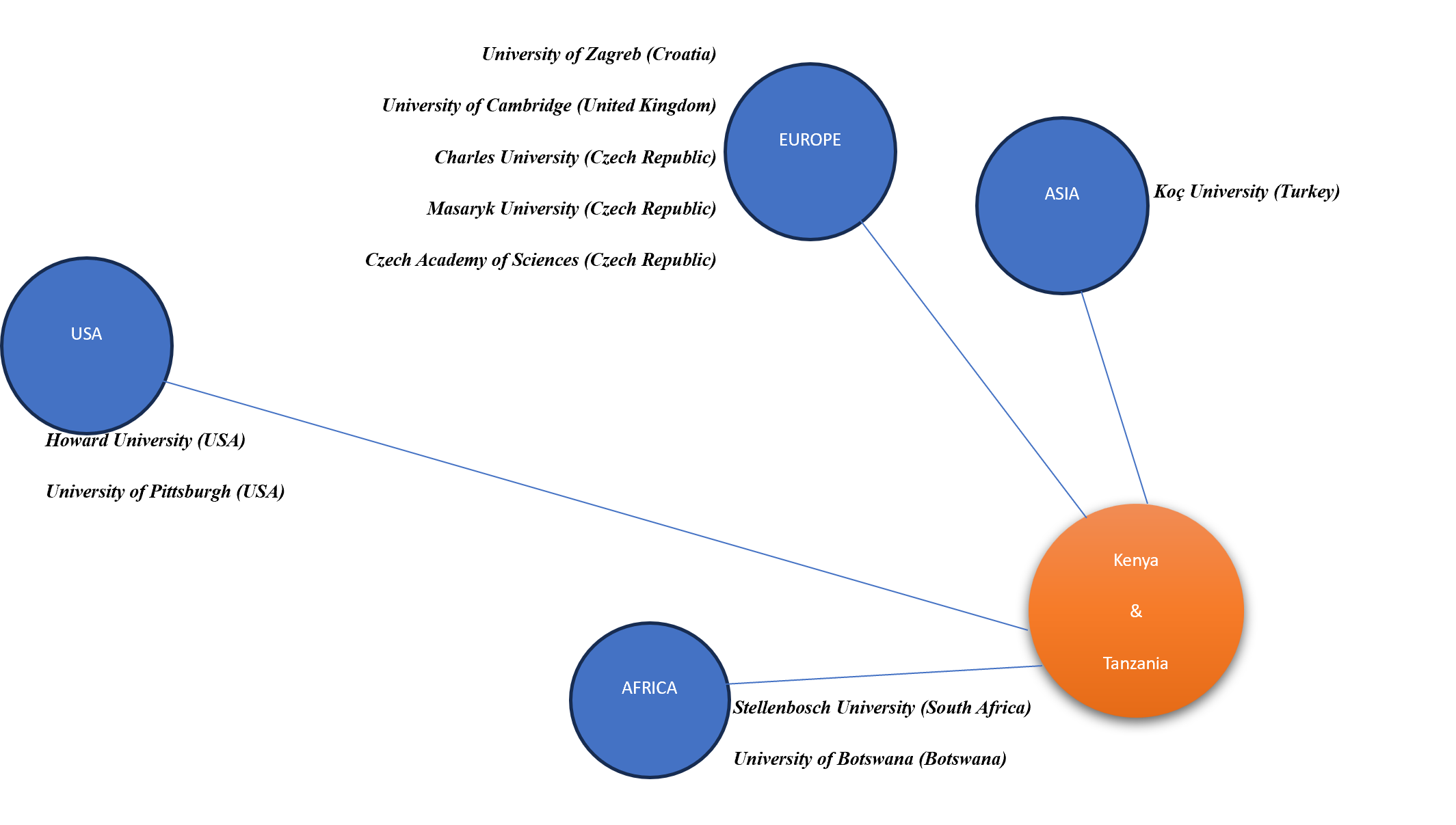
Each partner contributed by examining specific institutions. In total, 13 institutions were able to provide us with data. Howard University (USA), Stellenbosch University (South Africa), University of Zagreb (Croatia), Koç University (Turkey), University of Botswana (Botswana) and University of Pittsburgh (USA), Makerere University (Uganda), University of Cambridge (United Kingdom), Charles University, Masaryk University, and the Czech Academy of Sciences (Czech Republic), as well as University of Tartu and TalTech (Estonia). Across these institutions, important patterns emerged.
Fig 1: Global Benchmarking for Open Science
In countries such as Croatia, Estonia, the Czech Republic, and the United Kingdom, Open Science is supported by well-coordinated national systems, strong policy frameworks, and advanced research data infrastructures. Universities in these systems benefit from integrated repositories, clear guidelines, and alignment with international initiatives such as the European Open Science Cloud.
At the same time, institutions like Stellenbosch University, Koç University, and Makerere University demonstrate that meaningful progress can also be driven at the institutional level. Through strong leadership, capacity-building programmes, and well-developed repositories, these universities are advancing Open Science even where national systems are still evolving.
What makes this benchmarking particularly valuable is its relevance.
The exercise did not just document global practices, it identified approaches that can be adapted within Kenyan and Tanzanian universities. These include strengthening institutional repositories, integrating Open Science into postgraduate training, establishing roles such as Open Science champions and data stewards, and building communities that support continuous learning and collaboration.
It is a shared reference point for the FOSTER consortium which is a practical foundation that informs the development of infrastructure, curricula, and policy frameworks in the next phases of the project. Through this process, the partner institutions are not only learning from global leaders but are actively shaping how Open Science will be implemented, sustained, and scaled within East Africa.
Fig 2: From Global Learning to Local Implementation