
By Dr. Lydia Radoli: FOSTER Project Communication and Visibility Officer
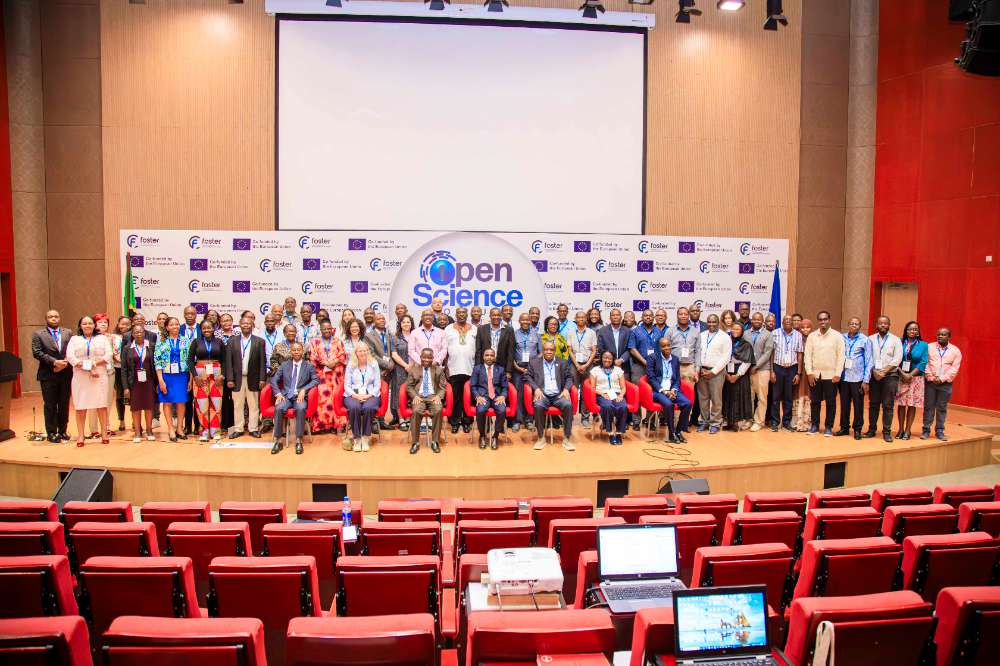
[Dar es Salaam, Tanzania]The second Open Science Forum (OSF2), convened at the University of Dar es Salaam from 23rd to 24th April 2026 under the three-year FOSTER Project Co-funded by the ‘European Union through the ERASMUS + programme’ under the Capacity Building for Higher Education (CBHE) Action consolidating renewed urgency to the push for inclusive, accessible, and collaborative research ecosystems across Africa and Europe.
The forum gathered academics, policymakers, and development partners from leading universities and research institutions to explore how Open Science can reshape knowledge production, governance, and societal impact. Built on the theme: Advancing an Open Science ecosystem for higher education in Sub-Saharan Africa, the forum underscored the growing alignment between African institutions and European Union frameworks such as Horizon Europe.
In his presentation, Prof Dr. Lucky Yona FOSTER Project Coordinator Eastern and Southern Africa Management Institute (ESAMI), emphasized that Open Science is not merely about access to research outputs, but a transformative shift toward transparency, collaboration, and community engagement in the research process. ESAMI is a Pan African Regional Management Development Centre owned by 10-member governments from the Eastern and Southern African region.
Leading the Daystar University delegation, Vice Chancellor Prof. Laban Peter Ayiro framed the forum within a global transition toward Open Science and citizen science ecosystems. He highlighted that Africa has a unique opportunity to co-create knowledge with communities, noting that this approach strengthens research relevance and positions universities as agents of societal transformation.
Prof. Ayiro further emphasized that collaboration with European Union partners enhances access to high-value research consortia, improves research governance, and strengthens institutional credibility and global visibility.
Complementing this perspective, Ms. Grace Mbogo- Daystar University Research and Protocol Officer and EU FOSTER Project Coordinator presented the FOSTER framework emphasizing the projects focus on building national and institutional consensus on Open Science, strengthening infrastructure, and embedding Open Science into University policies and curricula.
The initiative, which brings together FOSTER partner institutions, scholars, policy makers, students, researchers and invited guests to foster sustainable Open Science practices through capacity building, policy development, and citizen science initiatives.
European partners provided comparative insights into how Open Science has been implemented across different contexts. Presenting the Netherlands case, Prof. Marjolein Zweekhorst and Dr. Sarju Sing Rai of VU Amsterdam demonstrated that Open Science thrives on strong national coordination between universities, government, and research funders, supported by investments in digital infrastructure and policies promoting open access publishing.
Their presentation also highlighted five pillars guiding the Dutch Open Science programme monitoring, incentives, community empowerment, capacity building, and infrastructure, illustrating a structured and systemic approach to embedding Open Science in national research systems.
A similar European perspective was offered by Dr. Nada T. Širca and the ISSBS team from Slovenia, who outlined their country’s comprehensive Open Science Action Plan. They noted that Slovenia has established a strong legal and policy framework aligned with UNESCO recommendations, with measures such as mandatory data management plans, dedicated funding for Open Science, and integration into European platforms like the European Open Science Cloud (EOSC).
However, they cautioned that challenges remain, including the need for incentives, cultural change, and deeper integration of Open Science into higher education curricula.
From a research infrastructure perspective, Judith Bielsa of Fundación Ibercivis, University of Zaragoza emphasized the importance of interoperable and sustainable systems for Open Science. Her presentation pointed to fragmentation in data systems and the absence of shared standards as a major barrier to effective collaboration. She proposed a federal and modular infrastructure that connects existing platforms rather than replacing them, ensuring interoperability, quality validation, and long-term sustainability of research outputs.
Beyond infrastructure and policy, the forum placed strong emphasis on the social dimensions of Open Science. In their presentation, Lucía Moreno Juste and Dr. Olga Varela Machado from the University of Zaragoza highlighted the importance of intercultural and gender perspectives in shaping inclusive research processes. Drawing from participatory “World Café” models, they observed that research becomes more socially meaningful when communities actively shape research questions and co-create solutions.
They further underscored that diversity and inclusion including gender sensitivity and intercultural dialogue are critical to ensuring that Open Science does not reinforce existing inequalities but instead promotes equitable participation and knowledge co-production.
These insights were reinforced in policy-oriented discussions led by Prof. Lucky Yona from ESAMI who stressed Open Science global public good in its enhancement of transparency, acceleration of innovation, and enabling equitable access to knowledge.
Prof. Yona highlighted that while Tanzania has made progress such as establishing institutional repositories and policy dialogues, significant gaps persisted in infrastructure, funding, and coordination. He noted that addressing these challenges required investment in digital systems, capacity building, and the development of coherent national policies aligned with UNESCO principles.
The 2nd Open Science Forum (OSF_2) brought a diversity of academics, policymakers, and development partners at the University of Dar es Salaam- Tanzania 23rd to 24th April 2026
Across the forum, Open Science was consistently framed as both a technical and social transformation. Participants agreed that its success depends not only on digital platforms and policies but also on trust, collaboration, and sustained stakeholder engagement. The integration of citizen science, where communities actively participate in data collection, analysis, and problem-solving emerged as a central theme linking African and European experiences.
By the close of the forum, a set of broad recommendations had emerged from the deliberations. These included: the need to develop coordinated national Open Science policies, invest in interoperable and sustainable research infrastructure, strengthen capacity building and digital literacy, and institutionalize incentives for Open Science practices. Equally was the call to embed inclusivity, intercultural dialogue, and gender perspectives into research systems, ensuring that Open Science delivers equitable benefits across diverse communities.
As OSF_2 concluded in Dar es Salaam, it became clear that the Open Science movement is gaining momentum as a transformative agenda for higher education and research in Africa. With sustained collaboration between African universities and European partners, the forum has set the stage for a future in which knowledge is not only accessible, but co-created, inclusive, and responsive to the pressing challenges facing society.
